

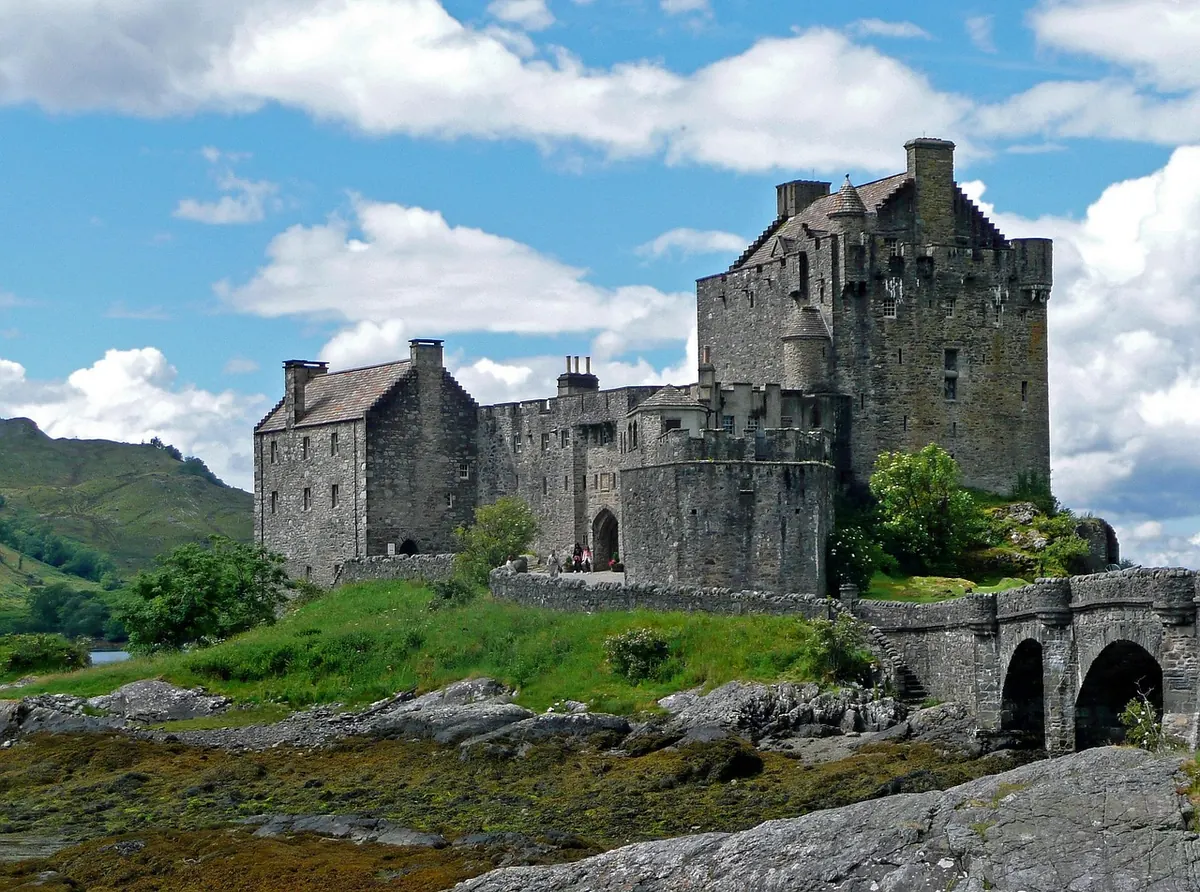
Loch Leven Castle sits on a small island in the middle of one of Scotland's largest lowland lochs, and for a few months in 1567 it held the most famous prisoner in Scottish history. Mary Queen of Scots arrived here in June of that year, defeated, exhausted and barely thirty years old. She left eleven months later, not as a queen but as an escapee, rowing across the water under cover of darkness. The castle she left behind is now one of the most atmospheric historic sites in Scotland — reachable only by boat, and all the better for it.
Where Loch Leven Castle Actually Is
The castle stands on Castle Island, the largest of several islands in Loch Leven, in Perth and Kinross. The nearest town is Kinross, just off the M90 between Edinburgh and Perth, and the main access point for visitors is the pier at Kinross. From the shore, the island looks close enough to swim to. It isn't, and you shouldn't try — the loch is cold, deep in places and exposed to sudden wind.
What surprises many first-time visitors is how low and flat the surrounding countryside is. This is not the dramatic Highland scenery of Eilean Donan or Urquhart. It is farmland, water and sky, with the Lomond Hills rising to the east. The castle itself has no romantic turrets or curtain walls in the fairy-tale sense. It is a compact tower house, built of grey stone, standing on a rise in the middle of the island.
A Castle Built for Defence, Not Comfort
The tower you see today dates largely from the fourteenth and fifteenth centuries, with the surrounding defensive wall added later. It was a Douglas stronghold for much of its history, and the family's grip on the loch made it a useful place to keep people — and to keep them out of sight.
Life on the island was not luxurious, even for royalty. The tower house has thick walls, small windows and a spiral stair. There was a hall, a kitchen and a few chambers, and the loch provided fish and wildfowl. But the water also isolated the castle completely. In an age before reliable roads, that isolation was the whole point.
The castle saw sieges, changes of ownership and long periods of quiet. By the time Mary arrived, it was already an old building with a reputation for being secure rather than comfortable.
Why Mary Queen of Scots Was Imprisoned Here
Mary's reign had unravelled quickly. In February 1567 her second husband, Lord Darnley, was killed in an explosion at Kirk o' Field in Edinburgh. Suspicion fell on James Hepburn, Earl of Bothwell, who was widely believed to be behind the plot. When Mary married Bothwell in May of that year, the country turned against her.
In June 1567, government forces met her supporters at Carberry Hill, east of Edinburgh. There was no battle. Mary's troops melted away, and she was taken into custody. She was brought first to Loch Leven, chosen because it was secure, remote and controlled by the Douglas family — whose head, William Douglas, was a half-brother of the regent Moray and no friend of the queen.
Eleven Months on the Island
Mary was lodged in the tower house, attended by a small household of servants and watched closely. She was not chained or starved. She was allowed to walk the island, to write letters and to receive some visitors. But she was a queen in a cage, and she knew exactly what was happening on the mainland.
The most brutal blow came in July 1567, when she was forced to sign papers abdicating the throne in favour of her infant son, James. He was crowned at Stirling a few days later, aged thirteen months. Mary never saw him again as a free mother.
The Escape of 1568
The story of her escape is the part most people remember. On the evening of 2 May 1568, Mary was helped out of the castle by a young member of the Douglas household, Willie Douglas, who stole the keys, locked the gates behind the household and rowed her across the loch to the shore near Kinross. She was hidden in a boat under a disguise, and by the time anyone noticed, she was gone.
She reached the mainland, gathered support and rode west. Within a fortnight she had crossed into England, hoping for help from Elizabeth I. She never returned to Scotland. She spent the remaining nineteen years of her life in English captivity, and was executed at Fotheringhay in 1587.
The island that held her for eleven months shaped everything that came after.
What You Can See Today
The castle is in the care of Historic Environment Scotland, and what remains is a ruin, but a substantial one. There is no roof, no furniture and no interpretive theatre. What you get is stone, water and quiet — which is, for many visitors, exactly enough.
On the island you'll find:
- The tower house, with its vaulted lower chamber and spiral stair
- Foundations of the hall and other buildings around the courtyard
- Remains of the curtain wall and the small harbour edge
- A few interpretation panels explaining the castle's history
- A short, uneven path around the island with views back to Kinross and the Lomond Hills
Allow around an hour on the island itself, plus the crossing. Wear sturdy shoes; the ground is grassy, uneven and often damp. Midges are a genuine issue from late spring into summer, especially on still, cloudy evenings. Take repellent.
How to Visit the Island
The crossing to Castle Island is by small boat from the Historic Environment Scotland pier at Kinross. The boat runs seasonally, roughly from spring through to autumn, and is weather-dependent — if the wind is up, crossings may pause. Tickets are usually combined with admission to the castle, and the boat carries only a small number of passengers at a time, so arriving early in the day gives you the best chance of getting across.
A few practical points worth knowing:
- Check sailing times and seasonal opening before you travel. They change, and the boat does not run year-round.
- Book or arrive early in peak season. Spaces are limited and cannot be expanded.
- There is no shop, café or toilet on the island. Use the facilities in Kinross before you go.
- The tower has steep steps and low doorways. Access around the island is not suitable for wheelchairs or pushchairs.
- Dogs are generally not permitted on the boat, so plan accordingly.
If you have time, walk or cycle the Loch Leven Heritage Trail, which circuits the loch for around thirteen miles and passes the pier. The view of the castle from the western shore, with the Lomond Hills behind you, is one of the best free views in Perth and Kinross.
Planning Your Trip
Kinross is easy to reach by car from Edinburgh, Perth or Stirling, and there are regular buses from surrounding towns. There is parking in the town and near the pier. Combine the castle with a stop at Loch Leven's Larder or a walk on the trail, and you have a full, relaxed half-day.
Loch Leven Castle is not the biggest or grandest ruin in Scotland. Its power lies in what happened there: a queen deposed, a child crowned, an escape by boat in the dark. Standing on the island, looking back across the water to the town, you get a clear sense of how small that world was — and how much turned on it.
Photo: Barni1 / Pixabay